
Dashboards frequently remain green until the point of catastrophic production failure. This is rarely caused by poor observability; it is usually a reliance on lagging indicators that hide systemic risks. A senior leader needs to move beyond current performance metrics and use horizon scanning. This involves the continuous assessment of architectural constraints, such as data types or throughput limits, to identify the structural ceilings that threaten future business continuity. A healthy system today doesn’t guarantee stability tomorrow. A senior leader must prioritise the mathematical facts that monitoring dashboards often ignore, to ensure the organisation is prepared for the next level of scale.
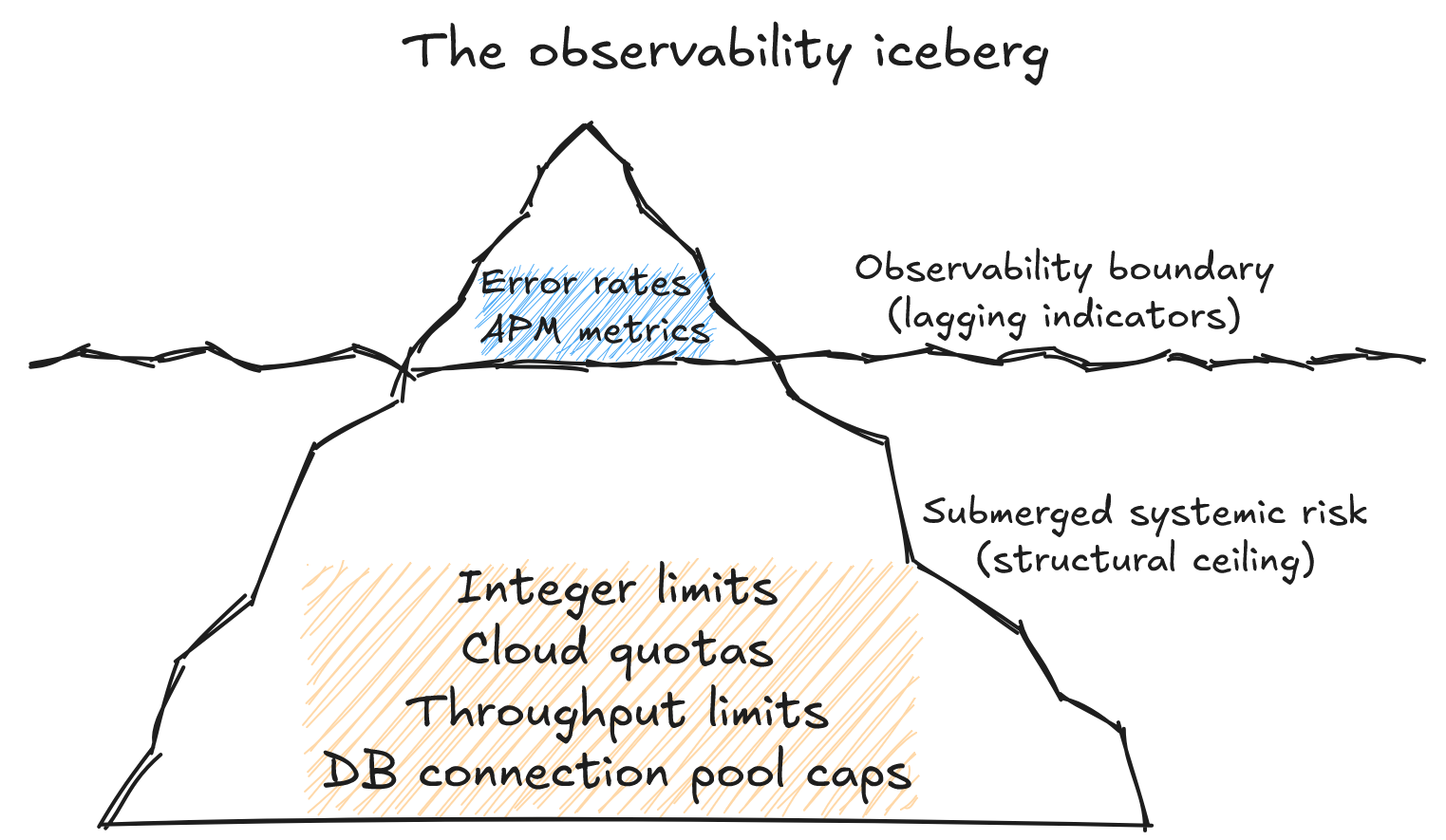
When green dashboards hide structural ceilings
When a staff engineer identifies a critical integer reaching its limit, the risk is rarely isolated. While the owner team understands this is not unique, dozens of downstream consumers have built logic assuming it is. A mathematical limit becomes a business crisis when a six-month runway clashes with a peak growth season, cutting your deadline to four months.
Moving to int64 is the cleaner path, but auditing forty impacted repositories is a coordination trap. In a high-stakes environment, the organisation cannot afford coordinating thirty teams with competing roadmaps. You must prioritise predictability over technical elegance. Often, the right move is the operationally messy path of resetting the integer and forcing a move to an existing alphanumeric ID, purely because it reduces the coordination effort. In senior leadership, a clean architecture is a liability if the organisation lacks the management energy to implement it before the system fails.
Execution requires moving beyond team-level status updates. Establish a core leadership group (including a technical project manager and a principal engineer) to manage a network of points of contact at the Head of Engineering level. This removes the friction of negotiating with thirty individual engineering managers. Even with top-down alignment, friction is inevitable. Some teams have competing contractual deadlines, others may unintentionally block all downstream systems. In these moments, you must be pragmatic. This means making difficult trade-offs: accruing short-term technical debt to unblock downstream dependencies earlier or negotiating manual reconciliation work with Finance to protect the delivery timeline. Your goal is to move the bottleneck from the code to a managed negotiation, ensuring the business continues to trade.
Translating architectural limits into commercial risk
Horizon scanning is not limited to technical debt; it must also account for commercial ambition. A system may appear robust under organic growth, but a proactive audit of the marketing roadmap often reveals silent, structural ceilings. Consider a scenario where the business intends to send 10 million text messages 15 minutes before a major World Cup match. Standard telemetry shows a healthy system, but the scan identifies a success disaster: the internal infrastructure cannot handle the concurrent request spike that this campaign will trigger.
A senior leader must translate technical jargon into commercial risk. Explaining database locks is less effective than describing a site crash during the most profitable fifteen minutes of the year. The goal is to move from a rigid refusal to a flexible negotiation, defining an approach that reduces risk without killing the campaign’s impact. This involves staggering the campaign at the provider level and segmenting high-value customers to hit the golden window while smoothing the remaining load. By doing this, you protect the system’s integrity while ensuring the highest-impact traffic is prioritised.
This process transforms the relationship between engineering and the wider business. Instead of reacting to a scheduled event, the organisation maintains readiness by pre-scaling infrastructure based on the marketing forecast and initiating proactive, hands-on monitoring well before the event. It also requires resolving any issues identified during load testing that exceed the expected baseline. In this context, engineering excellence is the proactive identification of where commercial hype meets architectural reality. You are not just managing traffic; you are auditing the commercial roadmap to ensure the system’s physical limits are never reached in production.
Turning discovery into permanent governance
Establishing a governance model, such as weekly readiness sessions between Tech Ops and Marketing, ensures that the insights found through horizon scanning are formalised into a standard operating procedure. Here, the senior leader’s role is to absorb the negotiation tax so engineering managers can focus entirely on execution. This tax represents the constant friction of justifying technical trade-offs to non-technical stakeholders.
However, if the senior leader remains the only person capable of navigating high-stakes friction, they become the next structural limit. Resolving this requires equipping your team with standardised commercial narratives: reusable communication playbooks that frame code issues as explicit business choices, such as trading a 30% checkout crash risk against staggering campaign traffic. By distributing these communication frameworks, the senior leader enables engineering managers to lead cross-functional negotiations independently, preserving executive capacity for higher-level strategy.
Horizon scanning in senior engineering leadership is the art of identifying silent architectural ceilings and turning them into managed, data-driven trade-offs. By turning mathematical limits into commercial choices, the leader ensures the organisation is limited only by its ambition.