
A talent review session. An EM moved under your remit a few months ago; their previous manager rated them close to high performance. Now you are evaluating the same EM as borderline underperforming. The previous manager was not mistaken; they were simply evaluating a strong senior engineer, while you are evaluating a leader.
This misalignment happens because the organisation lacks a shared, explicit standard. Without it, an EM defaults to shipping code instead of resolving cross-team dependencies, or they rely on an inherited team they cannot actually grow. The system never demanded they act as a leader. This creates an inconsistent management layer where engineers stall in their careers under one manager and thrive under another, creating a culture with unnecessary friction.
Managing managers one by one does not scale. Beyond a certain size, leadership is not about ad hoc individual coaching; it becomes explicit organisational design, defining and standardising the management layer to ensure consistency across the engineering organisation.
Standardising outcomes
Introducing a standardised competency framework creates friction: some long-term managers will push back, arguing that the goalposts are moving and that the organisation operated successfully without this extra bureaucracy. This pushback is a predictable response to protect their time and autonomy.
Raising the bar will cause a short-term drop in velocity. Not only by people adapting to the new standard, but also by attrition. Some managers will decide to leave the organisation, while others will fail to meet the new expectations and be managed out. A senior leader must accept this trade-off: sacrificing short-term delivery capacity to secure a consistently higher baseline of management quality that will benefit the entire organisation.
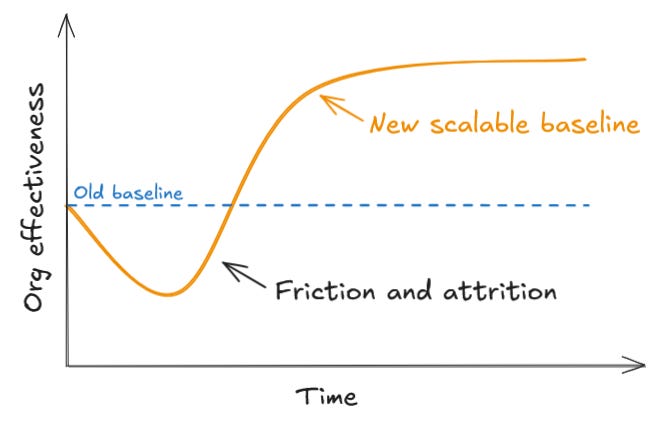
However, this transition requires deliberate investment: senior leadership reduces this friction by coaching managers on how to apply the framework, temporarily redirecting their energy to work effectively with the new standard.
To maintain autonomy and avoid micromanagement, the framework must standardise expectations, not judgement. A scalable framework defines the expected outcomes (e.g. running coaching-focused 1:1s, creating development plans) while leaving the execution path to the manager. Include example behaviours for each expected outcome, ensuring they are guidelines rather than checklists. Later, the calibration process assesses whether the manager’s chosen path delivered the expected outcome.
Avoiding the promotion checklist trap
Standard company-wide career stages inevitably fail engineering teams because they become promotion checklists rather than daily tools to increase impact. Decoupling role proficiency from the company-wide career stage removes this issue. Split proficiency into granular tiers (e.g. Fundamental, Established, Role Model) for each competency. This turns the framework into a continuous development tool, providing a shared language for coaching (e.g. proving an EM can be at a senior career stage but “Fundamental” in a brand-new competency).
Ensuring cross-functional impact
The goal of the framework is to create a scalable multiplier effect below the executive layer. Defining every single role creates unnecessary overhead. Exclude the VP and Director levels and target the layers managing 4-6 reports, where scalability is strictly required.
Leaders in an organisation define its culture. Standardising the Engineering management layer is powerful, but it creates friction if the rest of the functions in the Technology department operate to a different standard. Splitting the framework in two parts solves this. The foundation consists of shared core competencies applicable to all functions within the broader department (e.g. Engineering, Product Delivery, Design). The second part contains the specific role expectations purely for Engineering.
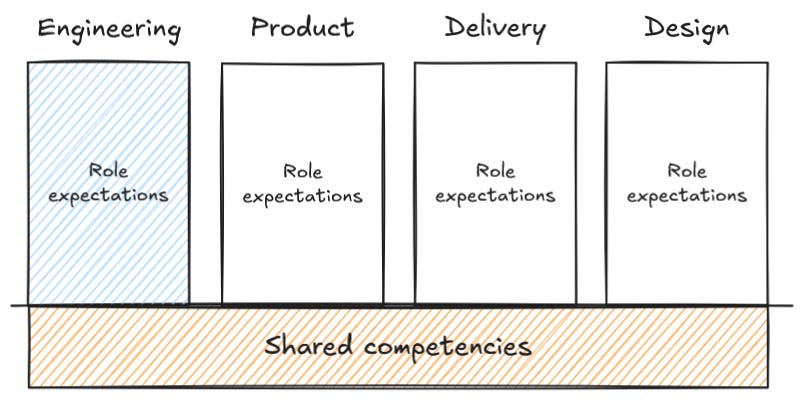
An engineering leader cannot define the specific expectations for product or delivery managers. However, having shared core competencies aligns the entire triad to a common baseline, reducing friction even if other functions have not yet defined their own frameworks.
Managing the new bottlenecks
Raising the management bar immediately strains the hiring budget. Recruiting to a higher standard becomes difficult if the existing compensation bands do not adapt to the new expectations.
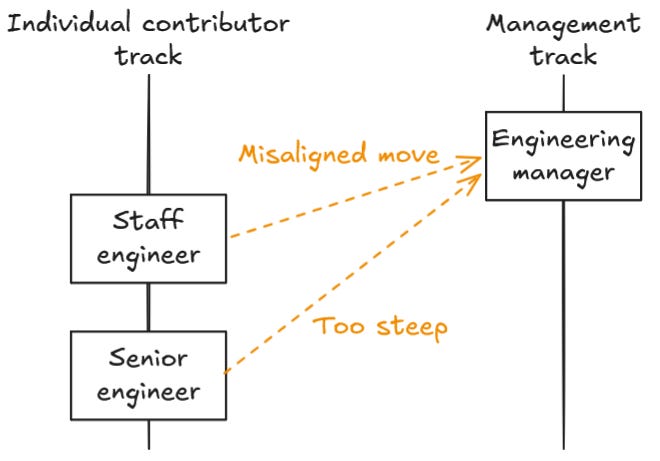
Upgrading the management framework also exposes cracks in other tracks. If the individual contributor track lags behind, there is an imbalance. The progression from senior engineer to engineering manager becomes too wide or unclear, and the supposedly lateral move from staff engineer to engineering manager turns into a difficult diagonal move.
When you accept a short-term drop in velocity to improve your management layer, Product and Sales will feel the impact. If you build this standard in a silo, you guarantee political friction. You need to negotiate this transition with your peers from day one, pushing Product leadership to align their own expectations in parallel.
Standardising the engineering management layer fixes your scaling problem but reveals your next-order constraint: it forces the rest of the business to either adapt to your new baseline or exposes them as the new bottleneck.